If you have watched a football broadcast in the last decade, you have likely heard some version of this line: "You have to establish the run for play action to work." It is one of those ideas that gets repeated so often it stops sounding like a claim and starts sounding like an established fact.
This piece examines whether that claim holds up. Using play-by-play data from the 2023–2025 NFL seasons, I looked at whether recent rushing volume — attempts and yards, both within the current drive and across the game as a whole — has any measurable relationship with play-action effectiveness. The analysis is also broken down by quarterback alignment (shotgun, under center, and pistol), since the "establish the run" idea is almost always told as an under-center story due to it's ability to enable "downhill" running.
The setup
For every play-action pass in the dataset, four "recent rushing" features were collected:
- Rush attempts earlier in the current drive
- Rush yards earlier in the current drive
- Rush attempts earlier in the game
- Rush yards earlier in the game
Each of these was tested against two outcomes: yards gained on the play-action pass, and EPA (expected points added) on the play-action pass. The analysis was run both across all play-action passes and separately within each QB alignment, using Spearman correlation to stay robust to the long tail of explosive passing plays.
The sample sizes by alignment:
- Shotgun: 5,229 plays
- Under center: 7,083 plays
- Pistol: 679 plays
Pistol is worth flagging up front. It is roughly a tenth the size of the other two groups, which matters for how much weight its results should carry.
The headline result
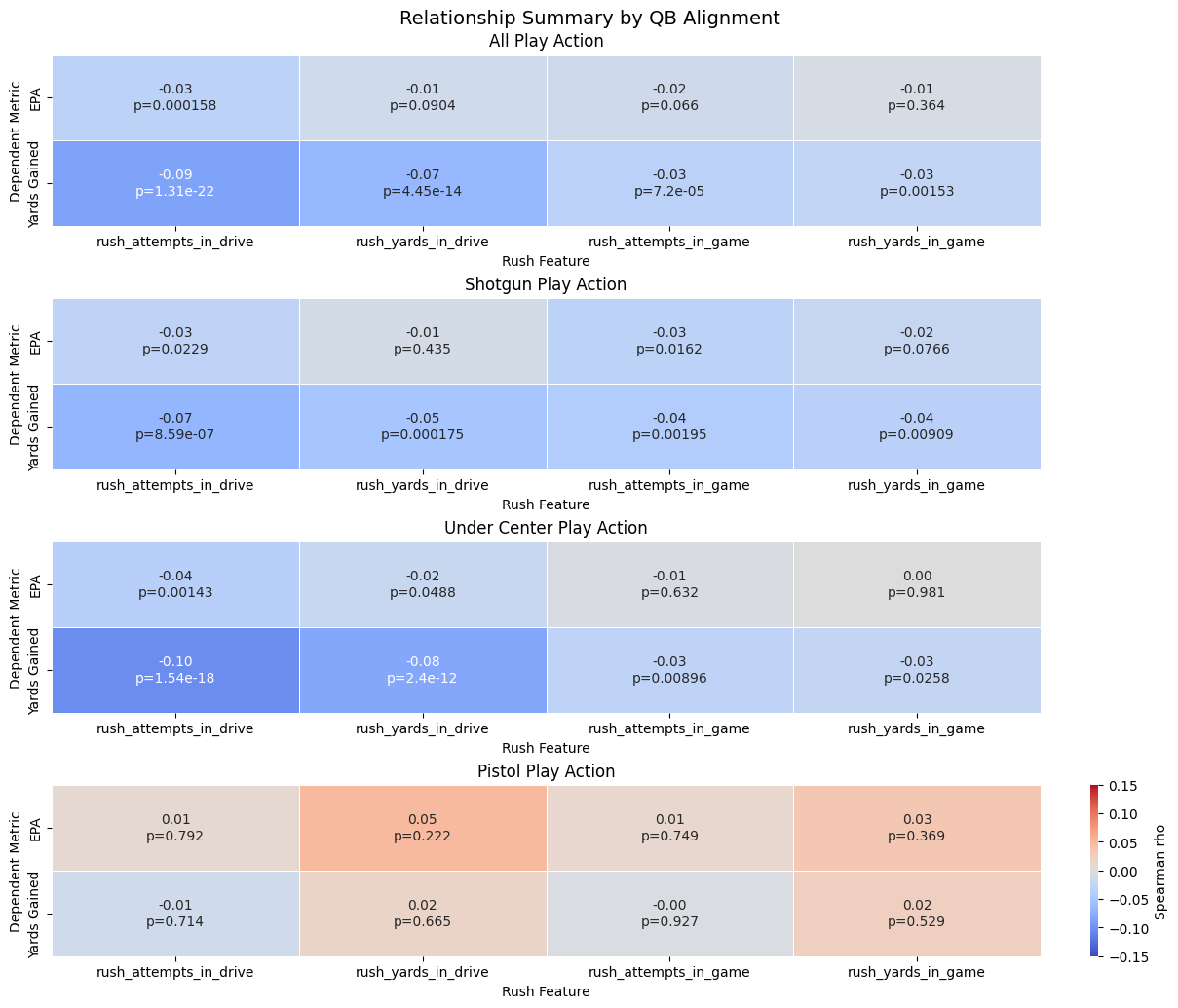
This heatmap summarizes the core result. Each cell shows a Spearman correlation, with p-value, between a rushing feature and a play-action outcome, broken out by alignment. A few patterns stand out:
- The relationships are real, but small. For shotgun and under-center play action, more rushing earlier in the drive or game correlates with fewer yards gained on the play-action pass — the opposite direction of the "establish the run" claim — and the effect is statistically significant (p < 0.001 in most cases). Even so, the correlations top out around -0.10, which qualifies as a weak relationship rather than a strong one.
- Yards gained shows more signal than EPA. The EPA row is largely flat and non-significant, suggesting that the additional yards on paper do not clearly translate into added win-scoring value once down, distance, and situation are accounted for.
- Pistol looks different, but likely due to sample size. Every Pistol cell sits close to zero and is not statistically significant. Given how much smaller this group is, that is better read as "not enough data to draw a conclusion" than as evidence that pistol play action behaves differently.
Outcomes look similar regardless of alignment
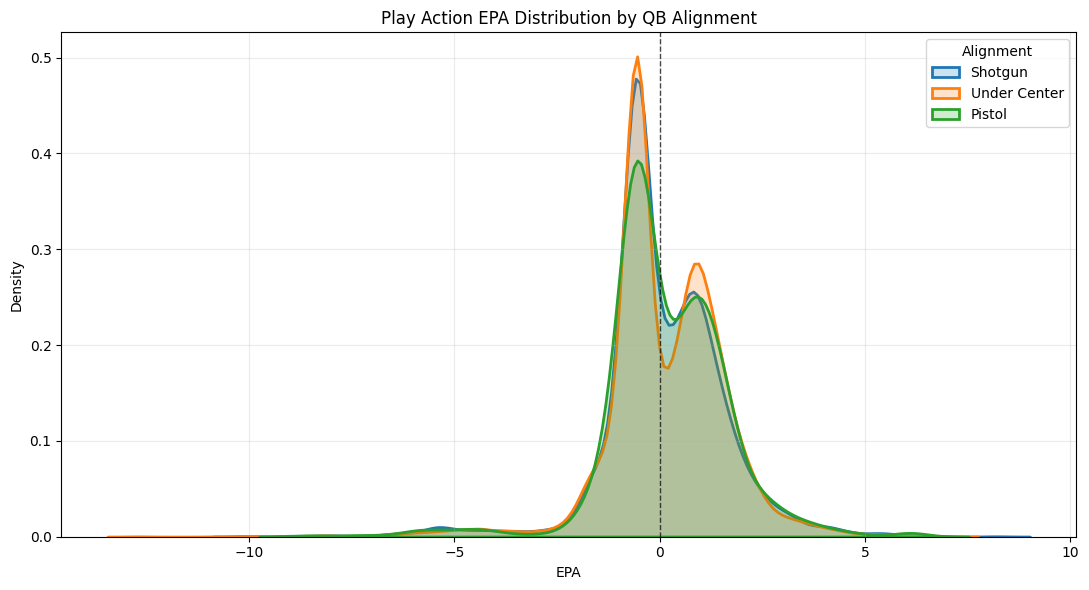
Setting rushing volume aside, it is also worth comparing how play-action passes perform by alignment on their own. The EPA distributions for shotgun, under center, and pistol are nearly identical. A Kruskal-Wallis test confirms there is no statistically significant difference between the three groups (H = 3.61, p = 0.16), and positive-EPA rates fall within two percentage points of each other (47–49%).
Whatever benefit play action provides, it does not appear to depend heavily on which alignment the quarterback is in — which itself works against the stronger version of the "establish the run from under center" claim.
What a "significant" relationship actually looks like
A p-value like 1.3e-22 can look like strong evidence at a glance. Below is the scatter plot behind the strongest relationship in the dataset — play-action yards gained versus rush attempts earlier in the drive, across all play-action passes:
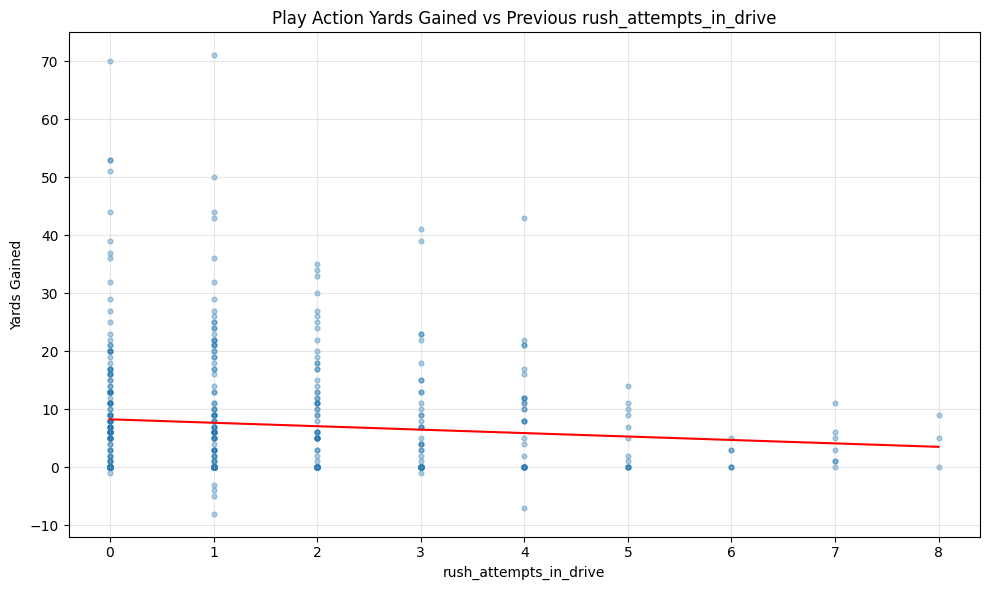
The trend line is statistically real, but it is barely a slope. The underlying data is heavily dispersed — large plays occur regardless of how many times the offense ran the ball beforehand. With over 13,000 plays in the sample, even a small, practically negligible trend clears the bar for statistical significance. It is a useful reminder that, at this sample size, "statistically significant" and "practically meaningful" are not the same thing.
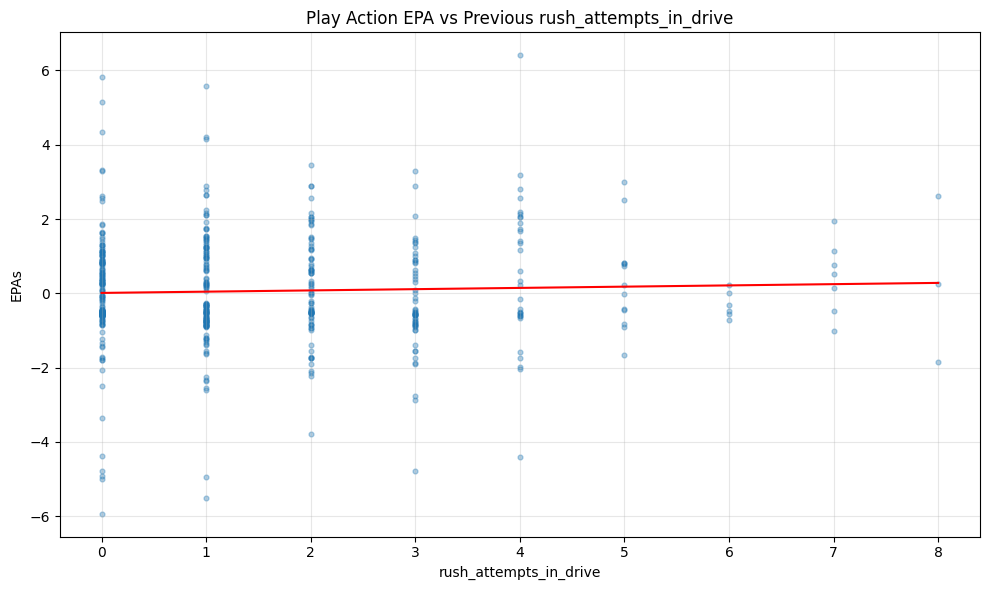
The relationship weakens further when the outcome shifts from yards to EPA:
Takeaways
A few conclusions seem reasonably supported by this data:
- Recent rushing volume has, at best, a weak relationship with play-action effectiveness — and where a relationship exists, it points slightly against conventional wisdom rather than for it.
- That relationship mostly disappears when effectiveness is measured by EPA rather than raw yards. Extra yards gained after a run-heavy stretch do not clearly convert into added win probability.
- QB alignment does not meaningfully change play-action performance, at least in aggregate — shotgun, under center, and pistol all fall within a similar range.
- The pistol results should be treated as inconclusive rather than as evidence of a genuine difference, given the smaller sample size.
None of this rules out the possibility that play action benefits from a credible run game in some more contextual, defense-specific sense — that is a harder question, and would likely require play-by-play information about defensive alignment and run/pass tendencies rather than volume counts alone. But as a broad claim across thousands of plays from the past couple seasons, "you have to establish the run for play action to work" does not have much statistical support.